

The Canada eTA application form asks a series of personal, travel, and background questions that every applicant must complete online. Knowing what to expect before you start filling out the form saves time, reduces errors, and helps you avoid delays or refusals.
This guide walks you through every section of the Canada eTA application, explains what each question asks, and shows you how to answer correctly.
What Questions Are on the Canada eTA Application Form?
The Canada eTA application form is divided into several sections. The questions cover your personal details, passport information, contact information, employment and travel history, and background questions about your health, criminal record, and immigration history. The form is only available in English and French.
You cannot save the form and return later, so have all your information ready before you begin. The entire process takes about 15 to 20 minutes.
Personal Information Questions
The first section of the eTA form collects your basic personal details. These questions are straightforward, but accuracy is critical because the information must match your passport exactly.
Questions asked:
- Family name (surname): Enter your surname exactly as it appears on your passport. Do not use nicknames or abbreviations.
- Given name(s): Enter all given names as shown on your passport, including middle names.
- Date of birth: Use the format shown on the form (day, month, year).
- Country of birth: Select the country where you were born from the dropdown menu.
- City of birth: Enter the city as listed on your passport.
- Gender: Select male, female, or another gender identity.
- Country of citizenship: Select the country of your passport. If you hold dual citizenship, select the citizenship you are using for this eTA application.
- Current country of residence: The country where you currently live.
How to answer correctly:
- Copy names exactly from your passport, including spelling and order.
- If your passport shows a middle name, include it. Omitting a middle name can cause a mismatch.
- If your name contains special characters (accents, hyphens), enter them as they appear on your passport.
- For dual citizens, use the passport from your visa-exempt country for the eTA.
A common reason for eTA delays or refusals is a name mismatch between the application and the passport. Double-check every character before moving to the next section.
Passport Information Questions
This section collects details about the passport you are using for your eTA. The eTA is electronically linked to your passport number, so these details must be correct.
Questions asked:
- Passport number: Enter the number exactly as shown on your passport’s data page.
- Country that issued the passport: Select from the dropdown menu.
- Date the passport was issued: The issue date printed on your passport.
- Passport expiry date: The expiration date on your passport.
How to answer correctly:
- The passport number may contain both letters and numbers – enter them carefully.
- Your passport must be valid for the duration of your trip. If your passport is close to expiry, renew it before applying for the eTA.
- The passport you enter here is the passport you must use when checking in for your flight. If you get a new passport after your eTA is approved, you must apply for a new eTA – the old one becomes invalid.
- If you hold multiple passports, use the one from your visa-exempt country.
For more on passport requirements, see our Canada eTA requirements guide.
Contact Information Questions
The eTA form requires a valid email address and your home address. IRCC sends all correspondence, including the eTA approval or refusal, by email.
Questions asked:
- Email address: A working email address you check regularly. IRCC will send your eTA confirmation here.
- Phone number: Your home or mobile phone number with country code.
- Home address: Your current residential address, including street, city, postal code, and country.
How to answer correctly:
- Use an email address you have immediate access to – you may need to check it for confirmation or follow-up requests.
- Check your spam or junk folder if you do not receive a response within 72 hours.
- IRCC may contact you by email if additional documents are required. Missing this email can delay your application indefinitely.
- Your phone number is used only if IRCC needs to reach you – it is not used for routine communications.
Employment and Travel History Questions
The eTA form asks about your current employment and recent travel history. These questions help IRCC assess your ties to your home country and your travel patterns.
Questions asked:
- Current employment status: Options typically include employed, self-employed, retired, student, homemaker, or unemployed.
- Employer name and address: If employed, the name and address of your current employer.
- Job title: Your current position or occupation.
- Have you previously been to Canada? A yes/no question about any prior visits.
- Have you previously applied for a Canadian visa or eTA? Whether you have submitted applications before.
- Have you been refused a visa or eTA for Canada, or been refused entry to Canada? A yes/no question about previous refusals.
- Have you ever been arrested, charged, or convicted of a criminal offence? A yes/no question about criminal history.
How to answer correctly:
- Answer honestly. IRCC cross-references applications with immigration databases and international watchlists. False answers can result in a refusal and a future ban.
- If you are unemployed or retired, select that option – there is no penalty for not having a job. The question is about your ties to your home country, not about requiring employment.
- If you have previously been refused, you can still apply. A previous refusal does not automatically mean a new refusal. However, be prepared for additional processing time and possible requests for supporting documents.
- “Criminal offence” includes DUI/DWI charges in many countries. Even a past DUI conviction must be disclosed. Canada treats impaired driving as a serious criminal offence.
For more on criminal inadmissibility, see our guide on Canada eTA with criminal record.
Background and Security Questions
The final section of the eTA form contains background questions related to health, security, and immigration compliance. These are the most important questions on the form and are the primary reason some applications require manual review.
Questions asked:
- Have you ever been refused entry to or deported from any country? Include all countries, not just Canada.
- Have you ever committed, been arrested for, been charged with, or been convicted of a criminal offence in any country? This includes offences that may have been pardoned or expunged in your home country.
- Have you ever had tuberculosis or been in close contact with someone who has? A yes/no health question.
- Do you have a serious medical condition that requires ongoing treatment? Health-related screening question.
- Have you ever been a member of, or associated with, a group that has committed or threatened to commit acts of violence? Security-related question.
- Have you ever been involved in war crimes, crimes against humanity, or genocide? A yes/no question.
How to answer correctly:
- Answer every question honestly. IRCC uses international databases (including Interpol) to verify answers. A false “no” on a background question is far more damaging than a truthful “yes.”
- If you answer “yes” to any criminal or security question, your application will be manually reviewed. This does not mean automatic refusal – it means IRCC will assess your specific situation.
- For tuberculosis: if you have been treated and cured, you may still answer “yes” and provide details. A past TB diagnosis does not automatically disqualify you.
- A “yes” answer to criminal questions does not mean you are permanently barred from Canada. You may be eligible for Criminal Rehabilitation or a Temporary Resident Permit (TRP).
- If you are unsure whether a past incident counts, disclose it. It is always better to over-disclose than to risk being caught hiding information.
| Background Question Type | If You Answer “Yes” | Typical Outcome |
|---|---|---|
| Criminal offence | Manual review required | May need Criminal Rehabilitation or TRP |
| Previous deportation | Case-by-case assessment | May need additional documentation |
| Health condition | Medical assessment may be required | Depends on condition severity |
| Security concerns | Thorough background check | Could result in refusal |
eTA Application Questions About Children
If you are applying for an eTA on behalf of a child, the form asks the same questions as for an adult applicant, with a few differences:
- The child’s own passport details are required – children cannot be added to a parent’s eTA.
- Parent or guardian information is collected in addition to the child’s details.
- Each child needs a separate eTA application and separate payment of CAD $7.
Children are subject to the same background questions, though answers related to criminal history or employment obviously do not apply to minors. Answer “no” for questions that are not relevant to the child’s age.
For full details on the application process, see our how to apply for Canada eTA guide.
Tips for Answering eTA Application Questions
Follow these tips to avoid common mistakes that delay or derail your eTA application:
- Have your passport open beside you while filling out the form. Do not rely on memory for passport numbers, issue dates, or expiry dates.
- Use the same spelling as your passport. If your passport says “Steven” but you usually go by “Steve,” enter “Steven.”
- Answer all background questions honestly. IRCC has access to international criminal and immigration databases. Dishonest answers are detected more often than applicants expect.
- Do not leave fields blank. If a question does not apply to you, select “No” or enter “N/A” where allowed.
- Complete the form in one session. The online form cannot be saved. If your session times out, you must start over.
- Have a credit or debit card ready to pay the CAD $7 fee immediately after completing the form.
| Common Mistake | Consequence | How to Avoid |
|---|---|---|
| Wrong passport number | Invalid eTA, boarding denied | Copy directly from passport data page |
| Name does not match passport | Delay or refusal | Enter name exactly as shown on passport |
| Leaving background questions blank | Application rejected | Answer every question – select “No” if not applicable |
| Using wrong passport (dual citizens) | eTA linked to wrong document | Use passport from visa-exempt country |
| Lying on background questions | Refusal + possible future ban | Always answer honestly |
| Passport about to expire | eTA expires with passport | Renew passport before applying |
What Happens After You Answer All Questions?
After completing all sections and paying the CAD $7 fee, your application is submitted to IRCC for processing. There are three possible outcomes:
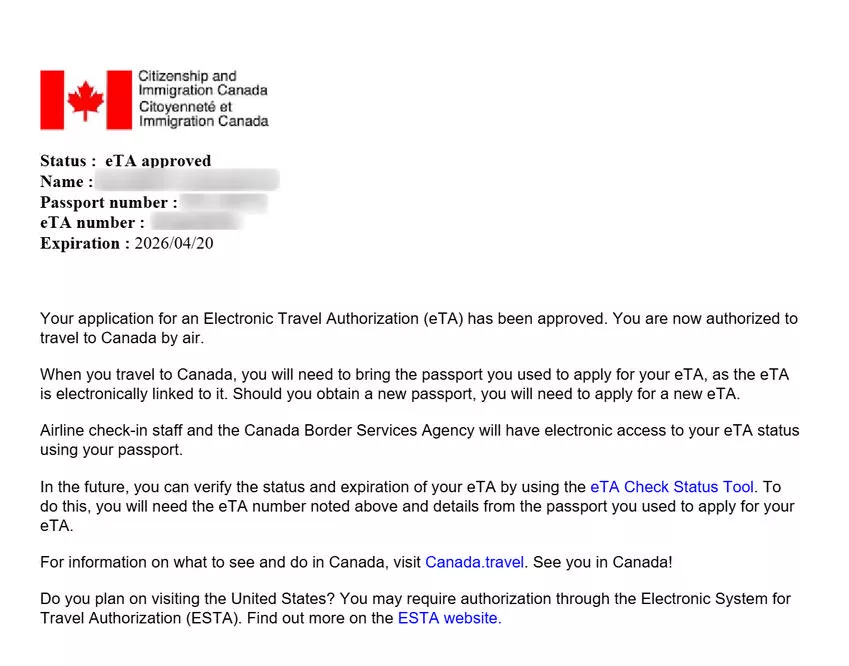
- Instant approval: Most applications (over 90 percent) are approved within minutes. You receive a confirmation email with your eTA number.
- Additional processing required: If your answers trigger a manual review – typically because of a “yes” on a background question or a name match – processing can take 72 hours to several weeks. IRCC will email you if they need additional documents.
- Refusal: If your application is refused, you receive an email explaining the reason. You can reapply or apply for a visitor visa instead.
The eTA is valid for up to five years or until your passport expires, whichever comes first. For details on fees and payment, see our Canada eTA fee guide.
Frequently Asked Questions About Canada eTA Application Questions
Can I complete the Canada eTA form in a language other than English or French?
No. The official eTA application form is only available in English and French. However, the Government of Canada provides translated help documents in several languages that describe what each field in the form means. You can use these help documents while completing the form in English or French.
What if I make a mistake on my eTA application?
If you notice a mistake after submitting, you cannot edit the existing application. You must submit a new application with the correct information and pay the CAD $7 fee again. If your first application is still being processed, the new one will typically override it. For critical errors like a wrong passport number, it is essential to reapply rather than travel with an incorrect eTA.
Do I need to answer background questions if I have no criminal record?
Yes. You must answer every question on the form, including the background and security questions. Even if you have no criminal record, you must explicitly select “No” for each background question. Leaving questions unanswered will cause your application to be rejected.
What if I have a DUI – can I still get a Canada eTA?
A DUI (driving under the influence) conviction is considered a serious criminal offence in Canada. If you have a DUI on your record and answer honestly, your eTA application will likely be refused. However, you may be eligible for Criminal Rehabilitation (if the offence occurred more than five years ago) or a Temporary Resident Permit (TRP). You can also apply for a visitor visa where you can provide additional documentation.
Will answering “yes” to a background question automatically refuse my eTA?
No. A “yes” answer triggers a manual review, not an automatic refusal. IRCC assesses each case individually. Depending on the nature and severity of the issue, your application may still be approved, or you may be asked to provide additional documents.
Can someone else fill out the eTA form for me?
Yes. A family member, friend, or travel agent can complete the eTA application on your behalf, as long as they have your passport details and correct personal information. The person filling out the form must answer the questions honestly based on your actual circumstances.
Do I need to know my exact travel dates to apply for an eTA?
No. The eTA does not require specific travel dates. It is valid for up to five years and allows multiple entries. You can apply for an eTA even if you do not have a confirmed flight booking. However, you may be asked about the general purpose of your travel.
What employment information do I need if I am self-employed?
If you are self-employed, enter your business name as the employer and your business address. For your job title, you can use your professional title (e.g., “Consultant,” “Business Owner,” “Freelance Designer”). IRCC uses employment information to assess your ties to your home country, not to judge your occupation.
I was refused entry to Canada years ago – must I disclose this?
Yes. You must disclose all previous refusals of entry or visa applications, regardless of how long ago they occurred. IRCC keeps permanent records of all immigration decisions. Failing to disclose a previous refusal is considered misrepresentation and can result in a longer ban from Canada.
Can I save my eTA application and finish it later?
No. The Canada eTA online form cannot be saved. You must complete and submit the entire application in one session. If your session times out or you close the browser, all entered information is lost and you must start from the beginning. Have your passport, email address, and payment card ready before you begin.
How long do the eTA application questions take to complete?
Most applicants complete the entire form in 15 to 20 minutes. If you have your passport and payment card ready, the process is straightforward. Applicants who need to look up employer addresses or travel history details may take slightly longer.
What happens if I leave the email address field blank?
You cannot submit the eTA application without providing a valid email address. IRCC sends all eTA confirmations and correspondence by email. There is no postal mail or phone notification. If you do not have an email address, you will need to create one before applying.