

US citizens do not need a Canada eTA. If you hold a valid US passport, you can fly to Canada without an Electronic Travel Authorization. The eTA requirement applies only to visa-exempt foreign nationals – and US citizens have a separate, streamlined entry process. This guide explains what US citizens actually need to enter Canada, when a green card holder might need an eTA, and how to prepare for a smooth border crossing.
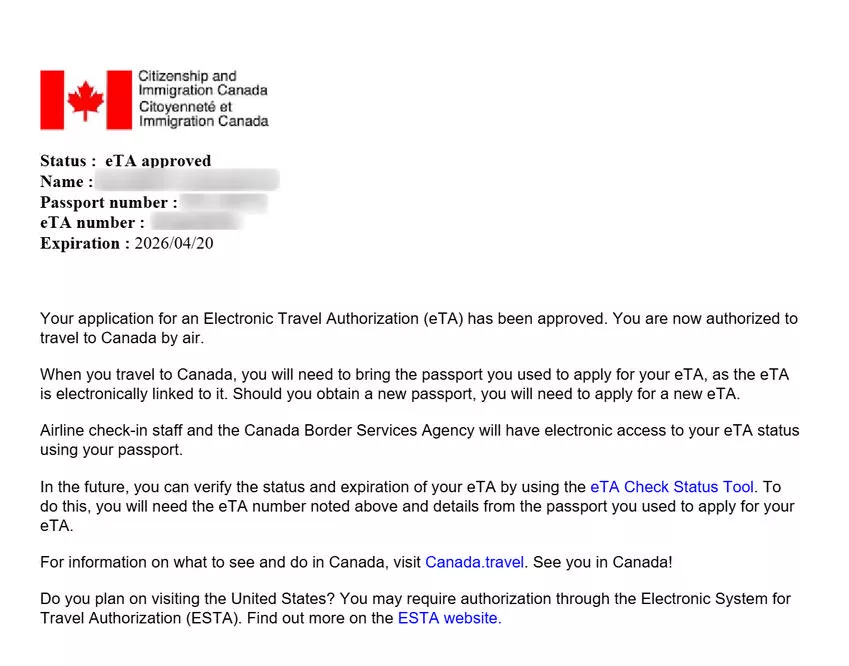
Do US Citizens Need an eTA for Canada?
No, US citizens do not need an eTA to travel to Canada. This is one of the most common questions about Canada travel, and the answer is straightforward: American citizens are exempt from the eTA requirement entirely.
When Canada introduced the Electronic Travel Authorization system in March 2016, US citizens were explicitly excluded from the requirement. Instead, US citizens need only two things to enter Canada:
- A valid US passport – this is the primary document for air travel to Canada
- Proof of US citizenship – a passport card, NEXUS card, or Enhanced Driver’s License may work for land and sea crossings
Key distinction: US citizens are not classified as “visa-exempt foreign nationals” in Canada’s immigration system. They occupy a separate category under the Canada-United States mutual agreements, which provides different entry rules than those applied to citizens of countries like the UK, Australia, or Japan.
What About Dual Citizens?
If you hold dual US-Canadian citizenship, you must carry a valid Canadian passport to board a flight to Canada. Airlines will not accept a US passport alone for Canadian dual citizens, because Canada requires its citizens to enter on a Canadian passport.
If you hold US citizenship plus citizenship of another country (not Canada), your US passport is sufficient – no eTA needed.
What Documents Do US Citizens Need to Enter Canada?
US citizens need a valid US passport to fly to Canada. For land and sea crossings, additional documents may be accepted depending on the entry method.
Documents Accepted for Air Travel
| Document | Accepted? | Notes |
|---|---|---|
| US Passport | Yes | Primary document for all air travel to Canada |
| US Passport Card | No | Not valid for air travel – only land and sea |
| NEXUS Card | Yes | Can be used at kiosks for expedited processing |
| Enhanced Driver’s License | No | Not valid for air travel to Canada |
| REAL ID | No | Not valid for international travel |
| Birth Certificate + Photo ID | No | Not accepted for air travel |
Documents Accepted for Land and Sea Travel
If you are driving across the border or arriving by boat, the Western Hemisphere Travel Initiative (WHTI) allows these documents:
- US Passport – accepted at all ports of entry
- US Passport Card – valid for land and sea crossings only
- Enhanced Driver’s License (EDL) – issued by certain US states (Michigan, New York, Vermont, Washington, Minnesota)
- NEXUS Card – provides expedited processing at land, air, and marine borders
- FAST Card – for frequent commercial travelers
Important: Starting May 7, 2025, the REAL ID Act requires a REAL ID-compliant driver’s license or another acceptable ID for domestic US flights. However, a US passport remains the required document for international travel to Canada by air.
Do US Permanent Residents (Green Card Holders) Need an eTA?
Yes, US permanent residents who are citizens of visa-exempt countries need an eTA to fly to Canada. This is where most of the confusion comes from. Having a US green card does not grant the same Canada entry privileges as US citizenship.
Green Card Holders: eTA vs Visa
The eTA requirement for US permanent residents depends on their country of citizenship, not their US residency status:
| Citizenship | Flying to Canada | Driving to Canada |
|---|---|---|
| Visa-exempt country (UK, Australia, France, etc.) | eTA required | No eTA needed |
| Visa-required country (India, China, Philippines, etc.) | Visa required | Visa required |
| US citizen | No eTA needed | No eTA needed |
Examples:
- A UK citizen with a US green card flying to Canada needs an eTA (CAD $7)
- An Indian citizen with a US green card flying to Canada needs a Temporary Resident Visa (TRV)
- A Mexican citizen with a US green card flying to Canada needs an eTA (Mexico became visa-exempt in December 2016)
Special Note: Expanded eTA Program (2023)
In 2023, Canada expanded its eTA program to include 13 additional countries whose citizens were previously visa-required. If a green card holder is a citizen of one of these 13 countries and holds a valid US non-immigrant visa (or has held a Canadian visa in the past 10 years), they may now be eligible for an eTA instead of a full visa.
The 13 countries added include: Antigua and Barbuda, Argentina, Costa Rica, Morocco, Panama, Philippines, St. Kitts and Nevis, St. Lucia, St. Vincent and the Grenadines, Seychelles, Thailand, Trinidad and Tobago, and Uruguay.
How US Citizens Enter Canada: Step by Step
US citizens entering Canada go through a straightforward process that does not involve an eTA application. Here is what to expect:
Before You Travel
- Check your passport expiry date – your passport should be valid for the duration of your stay, though Canada does not formally require six months’ validity beyond your stay
- Know what you can bring – Canada has strict rules about firearms, alcohol, tobacco, food, and agricultural products
- Prepare proof of ties to the US – while not always asked, having proof of employment, return ticket, or US residence can speed up your border interview
At the Airport (Flying)
- Check in with your airline – present your US passport. The airline verifies your passport electronically, but no eTA check is needed
- Arrive at the Canadian airport – proceed to the Canada Border Services Agency (CBSA) checkpoint
- Present your passport to the border officer
- Answer questions about the purpose and duration of your visit
- Receive entry stamp – most US citizens are admitted for up to six months
At the Land Border (Driving)
- Drive to the border crossing
- Present your passport, passport card, or Enhanced Driver’s License to the CBSA officer
- Declare goods – you must declare all items you are bringing into Canada, including gifts, alcohol, and tobacco
- Answer questions about your trip
- Proceed into Canada
How Long Can US Citizens Stay in Canada?
US citizens can stay in Canada for up to six months per visit, as determined by the border services officer at the port of entry. Unlike eTA holders, US citizens have a long-standing arrangement with Canada that allows extended stays without prior authorization.
Key Rules for US Citizens in Canada
- Six-month maximum per visit – the border officer stamps your passport with an expiry date, or you may be admitted without a stamp (in which case, six months is the default)
- No work without a permit – US citizens cannot work in Canada without a valid work permit, even for short periods
- No study without a permit – programs longer than six months require a study permit
- Extensions possible – if you need to stay longer than six months, you can apply to extend your visitor status from within Canada through IRCC
- No eTA renewal needed – since US citizens never had an eTA, there is nothing to renew. You simply enter with your passport each time
Frequent Travelers
If you travel to Canada frequently, consider applying for NEXUS – a trusted traveler program jointly run by the US and Canada. NEXUS members get:
- Expedited processing at airports and land borders
- Access to NEXUS kiosks at Canadian airports
- Reduced wait times at the border
- Cost: CAD $50 for a five-year membership
Common Questions US Citizens Have About Traveling to Canada
Can I Be Denied Entry to Canada as a US Citizen?
Yes, US citizens can be denied entry to Canada. Having a valid US passport does not guarantee entry. The CBSA officer has the authority to refuse entry for several reasons:
- Criminal inadmissibility – a DUI (driving under the influence) conviction, even a misdemeanor, can make you criminally inadmissible to Canada. Other offenses including theft, assault, or drug charges can also result in refusal
- Insufficient funds – you may be asked to prove you can support yourself during your stay
- Immigration violations – previous overstays in Canada can lead to refusal
- Security concerns – if you are on a security watchlist or have connections to criminal organizations
If you have a criminal record: You may be eligible for Criminal Rehabilitation (which permanently resolves inadmissibility) or a Temporary Resident Permit (TRP) (which allows one-time entry). Processing takes 6 to 12 months for Criminal Rehabilitation, so apply well in advance.
Can US Citizens Transit Through Canada Without an eTA?
Yes, US citizens can transit through Canadian airports without an eTA. If you have a layover in Canada on your way to another country, you do not need any additional authorization beyond your valid US passport.
However, if you plan to leave the airport during your layover (for example, to explore the city), you will go through standard CBSA processing as a visitor.
Do US Children Need an eTA to Visit Canada?
No, US citizen children do not need an eTA. All US citizens, including infants and children, are exempt from the eTA requirement. Children need their own valid US passport to fly to Canada.
For land and sea crossings, children under 16 can present a birth certificate or naturalization certificate instead of a passport. Children traveling with only one parent should carry a consent letter from the other parent to avoid delays at the border.
Do US Green Card Holders Need a Visa for Canada?
It depends on their citizenship:
- Citizens of visa-exempt countries (UK, Australia, France, Japan, etc.) with a US green card need an eTA to fly to Canada
- Citizens of visa-required countries (India, China, Philippines, etc.) with a US green card need a Temporary Resident Visa (TRV)
- For land crossings, green card holders can enter Canada with their passport and green card alone – no eTA or visa needed
Summary: US Citizens vs Other Travelers
| Category | Air Travel to Canada | Land/Sea Travel | Cost |
|---|---|---|---|
| US Citizen | Valid US Passport | Passport, Passport Card, or EDL | Free |
| US Green Card Holder (visa-exempt country) | Passport + eTA | Passport + Green Card | CAD $7 |
| US Green Card Holder (visa-required country) | Passport + Visa | Passport + Green Card + Visa | CAD $100-$150 |
| Visa-Exempt Foreign National | Passport + eTA | Passport only | CAD $7 |
| Canadian Citizen | Canadian Passport | Canadian Passport or other ID | Free |
| Canadian Permanent Resident | PR Card or PRTD | PR Card | Free |
Tips for US Citizens Traveling to Canada
A few practical steps before your trip can save time at the border and prevent common issues.
- Check your passport validity – while Canada does not require six months’ validity, ensure your passport covers your entire stay
- Know what you cannot bring – Canada prohibits certain items including firearms (without proper permits), pepper spray, and certain foods
- Declare everything – CBSA officers may search your vehicle or luggage. Undeclared goods can result in fines or seizure
- Get travel insurance – Canada’s healthcare system does not cover visitors. A single hospital visit can cost $3,000 to $10,000 without insurance
- Download the ArriveCAN app – while no longer mandatory for customs declarations, it can speed up your entry process
- Consider NEXUS – if you travel to Canada more than twice a year, the CAD $50 five-year membership pays for itself quickly
- Check road conditions – if driving in winter, Canadian roads can be hazardous. Carry winter tires and an emergency kit
FAQs About Canada eTA for US Citizens
Do US citizens need an eTA for Canada?
No. US citizens do not need a Canada eTA. A valid US passport is the only document required for air travel to Canada. US citizens are exempt from the eTA requirement under Canada-US bilateral agreements.
Can a US permanent resident travel to Canada without an eTA?
It depends. US permanent residents (green card holders) who are citizens of visa-exempt countries need an eTA to fly to Canada. Those from visa-required countries need a visa. For land and sea crossings, green card holders can enter with their passport and green card – no eTA or visa needed.
What happens if a US citizen has a DUI and tries to enter Canada?
A DUI conviction can make a US citizen criminally inadmissible to Canada, meaning they may be denied entry at the border. To resolve this, the person can apply for Criminal Rehabilitation (permanent solution, takes 6-12 months) or a Temporary Resident Permit (TRP) for a one-time visit.
How long can a US citizen stay in Canada without a visa?
US citizens can stay in Canada for up to six months per visit. There is no visa requirement and no eTA requirement. The border services officer determines the length of stay at the port of entry.
Can US citizens work in Canada with just a passport?
No. US citizens cannot work in Canada with just a passport. A valid work permit is required for any type of employment in Canada, including short-term and remote work performed while in Canada.
Do US children need an eTA to visit Canada?
No. US citizen children of all ages are exempt from the eTA requirement. Children need their own valid US passport for air travel. For land and sea crossings, children under 16 can use a birth certificate or naturalization certificate.
Can a US citizen be denied entry to Canada?
Yes. A valid US passport does not guarantee entry to Canada. CBSA officers can deny entry for reasons including criminal inadmissibility (DUI, theft, drug offenses), insufficient funds, previous immigration violations, or security concerns.
Do green card holders need a visa or eTA for Canada?
Green card holders from visa-exempt countries (UK, Australia, France, etc.) need an eTA to fly to Canada. Green card holders from visa-required countries (India, China, Philippines, etc.) need a visa. For land crossings, a passport and green card are sufficient.
Is a REAL ID enough to fly to Canada?
No. A REAL ID is only valid for domestic US flights. For international travel to Canada, US citizens must carry a valid US passport. A REAL ID driver’s license is not accepted for international air travel.
What is the fastest way for a US citizen to cross the Canadian border?
The fastest way is to join the NEXUS trusted traveler program (CAD $50 for five years). NEXUS members use dedicated lanes at land borders and automated kiosks at airports, significantly reducing wait times.